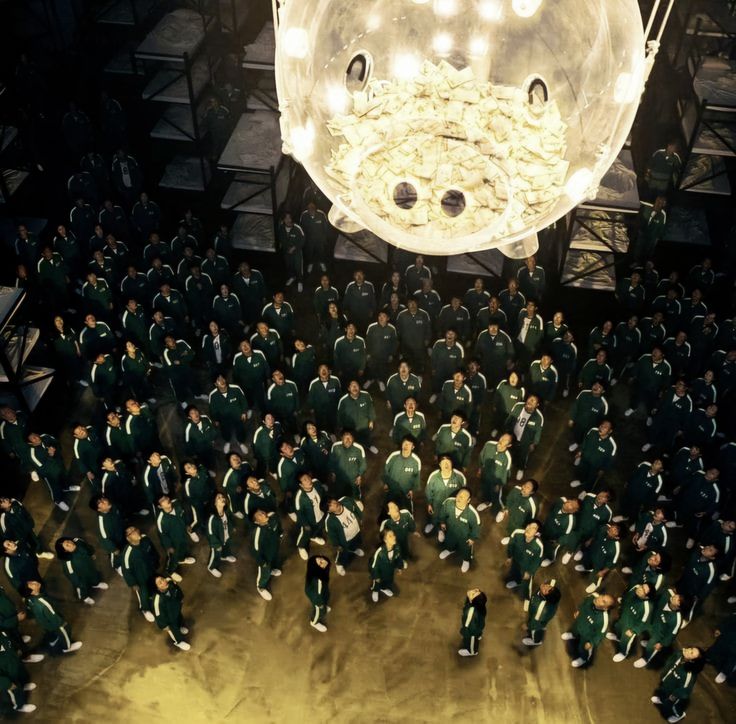
When Squid Game premiered on Netflix in 2021, it quickly became more than just another successful television series. It sparked conversations across the world about inequality, debt, morality, and the pressures of modern life. While many viewers were drawn to its suspense and shocking plot twists, others saw something much deeper: a reflection of the society we live in.
Although the series is fictional, many of the struggles faced by its characters are not. Financial insecurity, social inequality, and the pressure to succeed are realities experienced by millions of people every day. Rather than simply telling the story of a deadly competition, Squid Game invites viewers to question how modern society shapes our choices, values, and relationships with one another.
The Cost of Desperation
One of the most powerful themes in Squid Game is economic desperation. Every contestant enters the games because they are drowning in debt or facing financial ruin. Some have lost their jobs, others struggle with medical bills, while others are trapped by gambling addiction or failed businesses. Despite their different backgrounds, they all share one thing: they believe they have run out of options.
Technically, no one is forced to participate. In fact, after the first game, the contestants are given the opportunity to leave. However, many eventually choose to return because life outside the arena seems just as hopeless.
This raises an important question: Can a decision truly be considered free when every alternative leads to suffering?
The series suggests that poverty can limit freedom in ways that are not immediately obvious. While people may legally have choices, those choices become meaningless when survival itself is uncertain. In this sense, Squid Game argues that financial desperation can become a powerful form of coercion, even without physical force.
Equality Versus Fairness
Throughout the competition, the organizers repeatedly insist that everyone is treated equally. Every contestant wears the same uniform, follows the same rules, and competes for the same prize.
At first glance, the games appear fair.
However, equal treatment does not guarantee equal opportunity. Contestants enter the competition with different ages, physical abilities, health conditions, life experiences, and emotional resilience. These differences significantly affect their chances of survival, even though the rules remain identical for everyone.
This distinction reflects an important debate in political philosophy. Is justice achieved simply by treating everyone the same, or should society also address the disadvantages that people are born into?
Philosopher John Rawls argued that true justice requires more than equal rules—it requires institutions that reduce unfair inequalities. Squid Game illustrates how a system can appear equal on the surface while remaining deeply unfair underneath.
Human Nature Under Pressure
Perhaps the most fascinating aspect of Squid Game is not the games themselves, but how they transform ordinary people.
At the beginning of the competition, many contestants cooperate. They form friendships, protect one another, and work together to survive. Yet as the prize grows larger and the number of players decreases, trust slowly disappears. Alliances break apart, betrayals become common, and survival begins to outweigh morality.
Does money corrupt people, or does extreme pressure simply reveal who they truly are?
Psychological research suggests that scarcity and chronic stress can dramatically influence human behavior. When people believe that resources are limited, they often become more competitive, less trusting, and more willing to justify actions they would normally consider unethical.
Rather than portraying its characters as inherently cruel, Squid Game suggests that desperate circumstances can push ordinary individuals to make extraordinary moral compromises. In doing so, the series challenges viewers to consider how much of human behavior is shaped by personal character—and how much is shaped by the environment.
Wealth, Power, and Indifference
While the contestants struggle to survive, another group watches from a distance: the VIPs.
To them, the games are nothing more than entertainment. Human lives become objects of amusement, and every decision is simply another opportunity to place a bet.
The contrast between the contestants and the VIPs highlights one of the show’s strongest criticisms: extreme inequality can create emotional distance between those who have power and those who do not. Protected by their wealth, the VIPs never experience fear, hunger, or uncertainty. They observe suffering without empathy because they are disconnected from its reality.
Yet the final moments of the series challenge even them. When Gi-hun chooses to sacrifice himself instead of killing a baby to secure victory, the VIPs are visibly shocked. They had expected greed, violence, and self-preservation to triumph. Instead, they witnessed an act of compassion that their own worldview could not explain.
This scene serves as a powerful reminder that, regardless of wealth, status, or circumstance, every contestant is first and foremost a human being. The games reduce people to numbers, competitors, and sources of entertainment, but Gi-hun’s final decision restores the humanity that the system tried to erase. In doing so, Squid Game suggests that the greatest act of resistance against a dehumanizing society is not winning at all costs, but refusing to abandon one’s humanity.
Although exaggerated for dramatic effect, this message reflects a broader concern in modern society. As economic inequality grows, it becomes easier for those in positions of power to view others as statistics, workers, consumers, or competitors rather than as individuals with hopes, fears, and dignity.
Is Following the Rules Enough?
Another interesting aspect of Squid Game is its treatment of law and justice.
The organizers insist that the competition is governed by strict rules. Cheating is punished, contracts are respected, and every player supposedly has an equal chance of winning.
Yet legality does not necessarily mean justice.
Throughout history, many legal systems have operated according to clear rules while still violating fundamental human rights. By presenting a competition that is both organized and deeply inhumane, the series encourages viewers to question whether following procedures is enough to make a system morally acceptable.
After all, can desperate people truly give meaningful consent when refusing means returning to lives filled with poverty and hopelessness?
A Critique of Capitalism—or Something More?
Many people describe Squid Game as a criticism of capitalism. While this interpretation is understandable, it may also be too simplistic.
The series does not argue that markets or private businesses are inherently immoral. Instead, it appears to criticize societies in which economic inequality, overwhelming debt, weak social protections, and unequal opportunities combine to leave vulnerable people with almost impossible choices.
This distinction is important.
Rather than asking whether capitalism itself is good or bad, Squid Game encourages us to ask a different question:
What kind of society allows people to believe that risking their lives offers more hope than living their everyday lives?
That question extends far beyond economics. It touches politics, law, psychology, and ethics alike.
Conclusion
More than a survival drama, Squid Game serves as a powerful commentary on modern society. It explores how economic inequality shapes human behavior, how legal equality can coexist with injustice, and how competition can both unite and divide people.
Perhaps this is why the series resonated with audiences across cultures. The games may be fictional, but the emotions behind them—fear, ambition, insecurity, hope, and desperation—are deeply familiar.
Ultimately, Squid Game does not tell us what to think. Instead, it asks us to reflect on the kind of world we have created and the values that sustain it.
If ordinary people begin to see risking everything as their best chance for a better future, perhaps the greatest problem is not the game itself—but the society that made the game imaginable.


Leave a comment