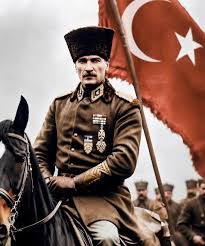
SOVEREIGNTY IS NOT GIVEN, IT IS TAKEN
MUSTAFA KEMAL ATATÜRK (1881-1938)
I wanted to begin my very first blog post with a quote that holds deep meaning for both myself and my country. These words by Mustafa Kemal Atatürk, the founder of modern Turkey, are more than just powerful— they carry the spirit of a nation that fought to exist.
A Quick Look Back: What Led Up to This Moment?:
After losing World War I, the Ottoman Empire signed the Treaty of Sèvres, which carved up its lands. It lost control over its Arab provinces, an independent Armenian state was created, Kurds were granted autonomy, and western Anatolia came under Greek occupation. In the face of these events, a resistance movement formed. Under the leadership of Mustafa Kemal Atatürk, the Turkish National Army began fighting not just the invading forces but also the remnants of the Ottoman regime. With some help from the Russian Bolsheviks, Atatürk’s forces succeeded. The last sultan, Vahdettin, fled to Malta with a British warship. Just three years after Sèvres, the Treaty of Lausanne made Turkey’s independence officially recognized. Soon after, Atatürk became the Republic’s first president.
POWER TO THE PEOPLE
Atatürk believed that a modern, fair, and just society could only be built on unquestionable popular sovereignty. That meant the people, not a monarch, should hold the true power of the state. Freedom, equality, and justice had to come from the will of the nation itself —not as a gift, not through compromise— but through the strength of its people.
Atatürk’s idea was simple yet bold: In order for a state to govern itself, it must have unconditional power. ->> This can only be achieved through “democratic autonomy” or “popular sovereignty”->> And that kind of sovereignty must be won, not handed over. ->> “Sovereignty is not given, it is taken.”
To me, the message is clear: The Turkish people won their independence with their own hands. This wasn’t something granted — it was something fought for. National sovereignty was officially declared on April 23, 1920, a date still celebrated in Turkey. For Atatürk, true independence wasn’t just about getting rid of foreign rule. It meant building a nation that stood on its own feet — politically, economically, and culturally. Reform wasn’t optional; it was essential.
Was Everyone Ready for This New Idea?
Well… not really. After over six centuries under monarchy, most people weren’t used to the idea of “the public” holding power. Especially in rural areas, many viewed Atatürk’s reforms — like secularism, education, and women’s rights — as something imposed by distant urban elites. Because of this resistance, Atatürk leaned on the support of the military to implement and protect the reforms. And the result was a secular, Western-leaning republic. But even today, the tension between secular modernism and religious conservatism remains a real and lasting feature of the Turkish society.
“There is only one power — the sovereignty of the people. There is only one authority — the existence, the awareness, and the conscience of the nation.”
Just like I started this post with Atatürk’s quote, I wanted to end with it too. Thank you for reading, and I hope you found something here that made you think.
With all my love…- Ayda

Leave a comment